
Vol. 2, No. 1
Table of Contents
Feline Nutrition:HELP!
Assist Feeding: Beloved Bert and Prescribed Drugs
Kitty Potpourri:Let’s Climb the Walls!
Caring for Cats:Declawing; The Controversy
Feline Nutrition – HELP!
by Garry White
Oh, what a bleak day it was to discover that I really don’t know everything, after all! I’m kidding, of course: Only teenagers know everything.
Anyway, I have a little dilemma that concerns feeding issues, and seriously, I could use some advice. I thought we’d have some fun with this, and I hope Kathy doesn’t fire me for presenting it this way.
Here’s the situation.
Clarkie, my oldster at about 15-16 years, lost some weight recently due to an abscessed tooth (couldn’t chew normally). Clark is a graze-feeder: Leave the bowl out, he nibbles throughout the day. Enter Wilbur, who is also very well mannered at the food bowl, and also not a voracious eater. Enter Ms. Gwen, who is another kettle of fish altogether. This docile, petite, meek little creature eats anything that doesn’t eat her first. She eats until the bowl or plate is empty, period. I tried to be sneaky about this, thinking: “Bigger bowl.she’s gotta fill up sooner or later, right?” Yep, she does.whereupon she simply turns her head to the left a bit, dumps the contents of her stomach on the floor, and continues eating until the bowl is empty; barely a break in the process. I’ve tried several ways to deter her from this obsessive eating, but it’s a waste of time; if food is present, Gwen is going to eat it.and then scour the house to see if she can find some more. I got Gwen from a “placement center”, and perhaps that’s the root of the problem; they were probably community-fed, and she had to get it before someone else did.
The dilemma.
Clark is an old cat, his eating habits have long since been established, and I’m not about to try forcing a new feeding regimen (such as meal-feeding, etc.) on him at his age.
Plus, he desperately needs the nutrition now.he needs a bowl of food present for whenever he’s hungry. Same with Wilbur: He, too, is an occasional eater, and I’m actually noticing that he’s getting a bit skinnier because of this situation. So the bottom line is this: Meal-feeding isn’t an option, since neither Clark nor Wilbur will eat enough food at one sitting to sustain them adequately. and if I leave the food out, Gwen gets it all.
I don’t wish to alienate Gwen by “scaring” her away from food bowls, and obviously I cannot keep her locked up or separated constantly. Just as obviously, I have to assure that Clark and Wilbur are getting enough nutrition.
How would you deal with this? This issue is one that’s probably common and troublesome to many, and I’d like to track it personally. I have a few thoughts of my own about how to deal with it, but I’d like to hear from those of you who have been there, or those who have ideas of your own. Please send your responses to Feedback(at)AssistFeed.com
Assist Feeding – Beloved Bert and Prescribed Drugs
by Kathy Fatheree
Over the holiday’s I met a couple over the Internet who were feverishly trying to learn about syringe feeding their kitty named Bert. I started emailing back and forth with them, quickly trying to learn more about Bert and what was going on with this beautiful guy. Bert had stopped eating completely and the vet had provided the standard can of a/d and the medicine syringe. This couple was trying their best to get the a/d into Bert, but he was fighting with all his might.
Learning a little more history about Bert, I found out 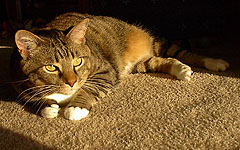 that his aversion to food began when the vet gave Bert the antibiotic Clavamox for kitty acne. From my own experience, Clavamox can either work as expected, or it can have terrible consequences. Clavamox was like a poison to my cat Phoebe. The first few days on this antibiotic were ok, and then every time I cave it to her she would foam at the mouth and throw up. She then started throwing up every time she ate. I told my vet what a terrible time we were having and he immediately had me stop the Clavamox and told me that it would take a few days to get it out of her system and then we would try something else. As I talked further with my vet, he told me that many cats cannot tolerate Clavamox. He said it’s generally a good drug, but at other times it causes this terrible reaction that I was witnessing first hand. Why don’t they warn of us before this happens? I think if the vet had warned Bert’s parents, they could have kept a watch out for food aversion. By the time Bert’s parent’s realized that Bert was not eating, it was perhaps almost a week later. They took Bert into the vet again, blood work was done and his liver enzymes were a bit off. The vet was not concerned about Bert’s weight loss of 2 pounds and said it would be good for him to lose a few pounds since he had previously weighed in at 17.5 pounds. At this point, Bert was no longer taking the Clavamox as he had completed his prescription. The vet then prescribed Ursodiol for his liver enzymes, but still was not worried about Bert and so this couple was continuing their syringe feeding with a/d.
Two things scared me about Bert’s situation. First, he had gone a week without food and the red flags concerning Feline Hepatic Lipidosis (FHL) were waving loudly in my face. Secondly, if Bert did NOT yet have FHL, perhaps the Ursodiol was making him feel sick and further causing him not to eat which would almost certainly lead him to FHL. After all, he exhibited drug sensitivity with the Clavamox. I looked up Ursodiol on the Internet and read the following:
“The following Ursodiol side effects may go away as your body becomes used to the medication; check with your doctor if they continue or become bothersome. More common side effects include back pain, and diarrhea. Less common or rare side effects from Ursodiol include constipation, dizziness, hair loss, heartburn, nausea, and vomiting.”
My thought is that if someone is feeling bad in the first place, could a drug like this cause him to feel even worse? Cat’s especially do not eat if they feel the slightest bit bad!
Bert’s case really upset me because a case like this should be treated aggressively. It’s so hard for the owners because as cat owners, we sometimes cannot see things right in front of our own eyes when it involves someone we love so dearly.
I do not know the outcome of this case. The last I talked with the owners, they were trying their best to get their vet to respond to their phone calls. I do know that they have an emergency clinic in their area, thankgoodness. Usually when I don’t hear back from people, it means that 1.) I’ve been too aggressive on the questions, 2.) There has been an email glitch, or 3.) The kitty did not survive and it’s just too painful for them to continue communication. I pray that in Bert’s case, once the Ursodiol was discontinued, he started eating again and he is just fine now. That is my prayer.
What can we learn from Bert’s case? That drugs, as much as they can save lives, can also cause our kitties to feel sick. Kitties that feel sick don’t eat. Any time your vet prescribes a new medicine for your kitty, keep a close watch on how much he or she eats. If you allow your kitty to graze (instead of meal feed), measure the food everyday to make sure that the food is really being eaten. and not just moved around the plate. Keep a close watch on your kitty and do not hesitate to call your vet as many times as it takes to find out the answers to your questions and concerns.
Kitty Potpourri – Let’s Climb the Walls!
by Dan Malenski
The title of this week’s article implies that the subject may be about the things our cats do that make us want to climb the walls in frustration! Not so at all, as it is really about what we could do for our cats that will enable them to climb walls, and have fun while doing so. Therefore, this week, we will talk about the variety of cat furniture that is designed to be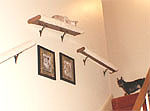 mounted on walls (similar in fashion to shelves) that will serve as an extension to our cat’s normal domain, that is, the floors, beds, and at least in my home, the counter tops and tables! In sum, what we will be talking about here are merely shelves of various sizes, strategically mounted on walls so that your cat may easily jump from one to another.
Wall mounted cat furniture had several advantages that I can think of at this moment, and I admit that I had some help from the “girls” with the following list:
- Wall mounted furniture or walkways serve as an extension of the floor and provide the cat with additional exercise and territory.
- Another advantage is safety. A cat that has access to such walkways on the walls will be less inclined to use your furniture as perches and keep that priceless vase that has been in the family since the beginning of time in one piece!
- Privacy is important to many cats, and some cats will use this space for a bit more privacy or a secluded spot to take one of their famous catnaps.
- Cats like high places to that they can supervise us or to escape from that dreaded vacuum cleaner.
- Wall mounted cat furniture may be used so that it blends in perfectly with the existing décor.
You will not find wall mounted cat furniture in your local pet shop, but a search on the internet will reveal many firms that carry it. Because you do not 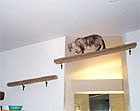 need an advanced engineering degree to construct the shelves, you may construct them yourself from materials readily available from your local home center and lying around the house, such as spare carpeting material. Another advantage of constructing them yourself, and perhaps the greatest advantage, is that you will be able to construct them out of materials that you choose, so that they do not detract from the appearance of the room.
If you do decide upon dedicating a wall or two of your home to your cats and choose to construct the walkways yourself, be sure to observe the cautions we outlined in earlier articles about cat furniture. Always securely fasten the carpeting to the shelving material so that it cannot be loosened by scratching or normal wear and tear. Carpet tacks of the appropriate size will do, as long as the shelf is a hard wood that will securely grip the tack over the long term. In addition, do exercise care when selecting a carpet material. Avoid the types that shred easily or use loops in its nap, which may snag a claw or two. Do insure that the carpeting covers all sharp edges and place a generous layer of foam underneath the area where your cats are likely to nap.
Placement of the “shelves” is limited by only your 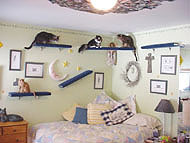 imagination and your creativity, but do employ commonsense in your planning. For example, do place them close enough so that they will not invite spills and, if possible, position them so that there are two ways “up” and “down” to avoid cats being cornered in multi-cat households.
If you do consider doing something like this for your cats, you may wish to hide this article from your cats unless you had coerced “Santa” into working overtime right up to Christmas Eve.
Caring for Cats – Declawing; The Controversy
by Garry White
A person with a warped sense of humor might put all of those in favor of declawing a kitty into a room with all of those who are passionately against the procedure. And then sell tickets to the performance. But that’s not me; I’d never do such a thing.
I suppose I’ll make a few enemies with this article, but hopefully a few friends will trickle in too, and with luck it’ll balance itself out. First off, let me say this: If you’ve chosen to declaw your kitty, I’m sure you did it for reasons you felt were necessary at the time, or perhaps from lack of understanding as to what’s really involved. Although I adamantly disagree with declawing a cat, please understand that I respect your decision to do what you felt was right.
Why the strong controversy over this? Let’s look at a few of the ups and downs of it, and then I’ll leave you to draw your own conclusions.
Are there good reasons to declaw? Perhaps. First of all, a cat with no claws minimizes the risk of contracting cat-scratch-fever (also called cat-scratch-disease, CSD); a pretty scary consideration until we look at the numbers: There are 295,180,060 people in the US, 60+million cats, and only 22,000 of us contract CSD annually.which means you stand a 0.007% chance of contracting CSD. And it’s noteworthy that CSD generally clears itself up in a few days. Okay, how about if there are new babies or young children in the house? A valid consideration if Fluffy is young and playful, or prone to rough play, but a more suitable approach would be to find Fluffy a home where they don’t declaw. Expensive furniture and clothes? Question: Which came first; the furniture or the cat? Question: Does the couch love you more than Fluffy?
Those are the positives. Bottom line, I cannot think of a reason that would justify declawing. The reasons for not doing so are far too extensive for this article, but for starters it’s the same as cutting your own fingers off at the first knuckle, the risk for surgical complications and infection is immense, and the kitty has absolutely no natural defense once it has been done. In several countries (including the UK), it’s actually illegal to declaw a cat.
Obviously, I’m opposed to declawing because it’s a dangerous, painful procedure to force upon a helpless being who loves us, as cats do.and it offers no worthy benefit. I do not slight those who have done so, but I have to ask: Knowing what you know now, would you do it again? If you’re considering this procedure for your kitty, I ask that you please take a few moments to read the following website article.
http://www.declawing.com
Disclaimer: Kathy Fatheree is not at all a medical expert. Contents of this web site are a collection of Kathy’s assist feeding experiences as well as the experiences of other cat owners who have assist fed their cats. While every effort has been made to ensure the accuracy of the information, Kathy Fatheree or anyone associated with this web site cannot be held responsible for anything that may happen as a result of using the information on this site.