Vol. 1, No. 29
Table of Contents
Assist Feeding – Finger Feeding
Feline Nutrition – Practicing What I Preach
Pro-Active Cat Care – “Pick Two”
Feline Obesity – When Diet Food Doesn’t Work
Kitty Potpourri -A Quiz for Cat Companions
Assist Feeding – Finger Feeding
by Kathy Fatheree
We have had a worrisome and challenging week around here fighting the kitty cold. A few weeks ago, little Nicholas sneezed for a few days and then was fine. I was hoping everybody was immune to this horrendous virus, but alas. we were not that lucky. Maya was the first to come down with the 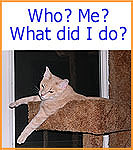 cold and she got so clogged up that she had to breathe through her mouth. This was not like the first time she caught a cold from Nicholas. it was 10 times worse. Maya stopped eating, stopped drinking and was lethargic and just felt yucky. After the first day of not eating, I said “OK little lady, I guess I get to assist feed you.” I didn’t have any special veterinary food, but I did have her PetGuard canned food that she enjoys. I tried all the tricks like warming the food up to make it more aromatic and appealing, but she had absolutely no interests in it at all. She usually goes bonkers over this food so this told me how sick she really was. So, what I did was this: I microwaved a cereal bowl of water for about 1 minute 20 seconds (just because that what I do for hot tea!) I then set a salad plate on top with her serving of food and let it sit for 3-5 minutes. This way I can warm the food without microwaving it. Maya can somehow tell when I have microwaved the food and she will not eat it. After I warmed the food, I sat on the floor with Maya in my lap facing away from me. Why facing away? I don’t exactly know, but I felt like I could control her better this way. I then scooped up a little food with my right index finger, gently pried open her mouth with my right thumb and scrapped the food off of my index finger with her top row of teeth on the side of her mouth. Amazing enough, she ate her food. She ate the whole serving! She did get a little agitated at the end of some feedings, but for the most part, I can get about ¼ of can in at each feeding. Maya weighs 7 pounds so ¾ of a can per day is good for her. NOTE: Before feeding Maya, I mushed the food with my finger to make sure there were not any bones or mystery chunks that could choke her.
THEN. a few days later, Miss Picasso came down with this same cold. It’s not fair that Mr. Nicholas only sneezed a few times and got over it. NOT FAIR AT ALL I SAY! Anyway, poor Miss Picasso got so clogged up that not even a wisp of air could pass through her nose. She had to breathe through her mouth. I think that what she should have been sneezing out became trapped in swollen tissue. Her entire face looked oddly puffy to me. Nobody else would have noticed, but I could tell. This all came on so terribly on Saturday night. She was having labored breathing so I stayed up all night watching her breathe. Sunday morning I took her to the emergency vet just to make sure nothing else was going on, but thankfully they just said it was a bad cold. “the colds this year have been quite severe” they said. They sent me home with antibiotics and a can of Hill’s a/d food and a syringe. Miss Picasso is normally a good eater so I thought I would try finger feeding her as well. With Miss P, though, I sat her on the floor in front of me. Why? I don’t know. it just felt right. I again warmed the food like I described above, scooped up some food with my index finger, set my left hand on her back, teased her mouth open with thumb and then. here is what’s different. I wipe the food on her tongue! How neat! And she let’s me do this! Like Maya, she gets a bit agitated when she’s had enough food, but I get most of her servings in! How lucky I am to have such great cats! I’ve never finger fed before and this is working wonderfully.
If you are struggle with syringe feeding. try finger feeding! You’ll come up with your own personal style that works best for you!
Feline Nutrition – Practicing What I Preach
by Garry White
I bet some of you wonder if I actually do the stuff I send forth from here as recommendations. You bet I do! I’ve learned (and I’m still learning!) that the details will getcha if you let ’em. I’ve also learned to go with the facts, and nod pleasantly at parlor talk. The fact that a cat has eaten the wrong foods for years (and hasn’t croaked yet) doesn’t impress me. Bragging that a kitty table scraps most of the time (and he/she seems just fine) will produce only my glassy look and a nod or two. And I won’ t even argue, for a couple of reasons: One, it’s not my cat. Two, I’m a step ahead of the game, because I know what’s happening inside that cat. I know, for example, that a high-fat diet of cheap dry foods that are loaded with ash, fillers, and very little (or poor quality) meat protein, will certainly assure that Fluffy won’t be here as long as she might have been, with better care. Please understand that I’m not referring you our readers; we already know that you folks are conscientious and caring, and want only the best for your kitty. The folks I’m talking about are the ones who treat pet care with an “Ah, what’s the big deal?” attitude.
Feline nutrition is a big deal, and a complex one to boot. In fact, given all the choices (and manufacturer’s claims) before us, managing a kitty’s diet can be downright frustrating! But it can’t be helped; those little details mean everything to Fluffy. Here’s a classic example: I used our very own Nutrition Calculator on a poor food and a good one, and I looked only at calcium and ash content. If we assume an average lifespan of 15 years (5,475 days), and assume we’re using the poor food, we’re asking organs smaller than a thimble to process 3.7 more POUNDS of calcium than with the better food, and 18.12 POUNDS more ash. So you see, those little details aren’t so little, after all.
You all know that I’m shy about making recommendations, but given the research I’ve done for this Newsletter, and the knowledge I’ve gained, I’d have to lean toward holistic foods if forced to jump off the fence. Right or wrong (and only time will tell), the logic is clinically sound. Those foods use only human-grade ingredients, with extreme attention given to every single element. My guys are eating about 90-95% of a holistic food now, and I’m seeing a very positive difference. Wilbur doesn’t count, of course, because Wilbur will eat anything not bolted to the floor. But Clarkie is perkier, more active, more “interested” in life in general.
So.do I practice what I preach? Yessir, Ma’am, I surely do. I record things (like litterbox habits, general demeanor, eating/drinking consumption, etc.), I drop a bag of donuts off at the vet shop occasionally to help keep that association intact, and I watch my two guys’ diets closely.
As for non-cat foods: Try a little French dressing on that next corned-beef sandwich.yummy!
ProActive Cat Care – “Pick Two”
by Garry White
A friend of mine (Don Banks) is in the business of manufacturing solenoid valves, which he sells to me and to a few thousand other folks around the planet. His business exposes him to customers who want only the highest possible quality of valve, at scrap-metal prices, and they want it yesterday afternoon. In other words, they want it all. Don’s answer to this is clear and to the point: “You can’t have it all. You can have it cheap, or you can have it good, or you can have it fast.pick two.” Well now. I guess that says it all, doesn’t it? Mind you, our little Fluffy doesn’t run on 12 or 24 volts, but if we substitute ‘cheap’ with convenience and ‘good’ with quality, Don’s logic is sound as a rock, and it applies directly to the topic du Jour.proactive cat care. So often, we are like Don’s customers, and I’m not excluding Yers Trewly. We want the vet to be next door, we want him/her to be highly qualified, and we feel they shouldn’t charge us more than a couple of bucks to save Fluffy’s life. It ain’t gonna happen folks. Quality care is not cheap, and if $$$ are your measuring stick, then the quality of care may suffer. And if convenience is your main concern, then expect to be surprised at the cash register, and settle for whatever care is provided. Them’s the rules of life, friends. Those of us who have been around the block with a loved pet (or an uppity valve manufacturer!) know there’s no such thing as a high road to panacea, and those of us who haven’t.well, there’s a pretty good chance that you’ll find out one day.
I cannot get a high quality, cheap valve from Don Banks in a hurry, nor do I have any right to expect such. Truth is, he didn’t create my urgent need for valves, and the vet didn’t make my kitty sick. They’re responding to our needs, and that’s the operative phrase.our needs. It’s up to us as primary caregivers to understand these elements thoroughly, and to seek out the best of all worlds. The onus isn’t on the provider; it’s on us. Sure, we want quality care for our babies, we want it on a timely basis, and we don’t want to be ripped off. Makes sense, but these things aren’t going to fall in our laps, and we shouldn’t expect them to just because Fluffy needs attention. The only way to assure such idyllic conditions is to marry a vet, but that only works with cats: Personally, I don’t care how good Don’s valves are, I’m not marryin’ him, and that’s final!
So, what to do, you ask. Same as I always tell you: PREPARE! Know the parameters and guidelines, and set them to your advantage. But do it when you can, not when you need to! When Fluffy is healthy, eating well, playing, peeing & pooping like a pro; that’s when you set the stage for days ahead that may not be quite so sunny. Wait for a crisis, and you’re stuck with whatever is presented to you.
I’ll close with this: If Wilbur develops terminal strips for connecting wires, Don Banks and I are going to have a long talk.

Disclaimer: Kathy Fatheree is not at all a medical expert. Contents of this web site are a collection of Kathy’s assist feeding experiences as well as the experiences of other cat owners who have assist fed their cats. While every effort has been made to ensure the accuracy of the information, Kathy Fatheree or anyone associated with this web site cannot be held responsible for anything that may happen as a result of using the information on this site.