Vol1 No28
Table of Contents
Assist Feeding – One Day without Food
Feline Nutrition – Raw vs Cooked
Pro-Active Cat Care – Pet Factories
Feline Obesity – What is FHL?
Kitty Potpourri – The Ultimate Cat Caper!
Assist Feeding – One Day without Food
by Kathy Fatheree
So what if your kitty suddenly becomes ill? Is it something she ate? Does he have a hairball? If your cat is lethargic, has a fever, appears to be in pain or anything else that just seems really wrong, take your cat the vet or emergency vet clinic away. Other things like hairballs seem to work themselves out in a days time. Over time, the observant cat owner can learn their cat’s behavior so be ever watchful to know your cat’s every move so that when he or she does get sick, you will notice immediately.
When my long hair kitty got a hairball, she would not eat, but she would drink the water I mixed with her food, and then usually the next morning I would get out of bed and. step right on a wet, yucky hairball. I could always tell when she was starting to get a hairball and it was not unusual for her to skip a meal or two. I learned her pattern and we worked with it.
But what if your cat doesn’t seem the slightest bit interested in food. even seems to be repulsed by it when you set the food down in front of kitty? Something’s wrong. I’d get kitty to the vet. If your vet finds nothing wrong, he will send you home and say to keep an eye on kitty. Often times vets aren’t as concerned as I think they should be so it will be up to you to really watch carefully.
The most important thing you can do is to get food and water in your baby. One day without food is probably ok. but two days is absolutely not. Be careful not to let one day slip into two slip into three. If you do, you are asking for trouble. It’s a good idea to keep a feeding syringe on hand and also some canned food, preferably a food that is a pate. a food that is a smooth without chunks. It is imperative that you syringe feed your kitty to get essential nutrition in her. That old saying Feed a Cold . Starve a Fever. or is it the other way around? Well whatever it is. it does not apply. Any cat that is sick needs excellent nutrition to get better. Kitty also needs water so as not to become dehydrated. If you syringe feed a canned food, you can add a little water to the mix.
Before your cat takes sick, go to the pet store and buy:
- A feeding syringe and
- Canned pate cat food.
If you cannot find a pate, be sure to have a potato masher or food processor so that you can make your own pate. It’s also a good idea to practice syringe feeding your cat while he or she is healthy and hungry so that your cat will be more accepting of the process when or if the time ever arises that you need to assist feed.
Sometimes an animal will just be “off her feed” and things will get back to normal the next day. However, remember, it is not normal to be “off his/her feed” so watch out and be prepared with assist feeding supplies.
Feline Nutrition – Raw vs Cooked
by Garry White
Well, adventurer that I am, I wandered off the beaten path this week into the unseemly and controversial arena of raw foods versus cooked foods. First off, I stumbled headlong into a pit of snakes: Maillard reactions, polycyclic aromatic hydrocarbons, mutagenicity, and of course the obvious “cooking=toxicity=disease paradigm” theory. Obvious to them, maybe, but I have to be honest: It was like trying to teach non-Euclidean geometry to a field mouse. I spent more time with Mr. Webster than I did learning about the subject at hand. But I did learn a few things, though, and what I learned left me wary.
In order to understand where I’m headed, we have to look behind us. We’ve all heard the old phrase: “The perfect cat food is a mouse.” Well, that’s probably not true. Yes, that’s what cats ate centuries ago, but evolution changes things, and our systems adapt to those changes. A vet I asked about this agrees: A cat of today restricted to a diet of snakes, rodents, and birds.probably wouldn’t live very long. I guess the proof in that is the vast difference in life expectancy between an outdoor cat (which eats from the wild), and an indoor cat (which eats processed food). True, there are plenty of reasons an outdoor cat has a shorter lifespan, and among them are poor diet, lack of nutrition, and ingested bacteria. So what I’m saying is: We cannot compare Fluffy to a cat of 100 centuries ago, anymore than we can compare ourselves to cavemen. We have to treat Fluffy’s digestive system with respect to its evolutionary adaptation.
Given all that, let’s look at some of the ups and downs of both raw and cooked (processed) foods. Raw foods are the way nature made them, and some will argue that living organisms (that would be us and Fluffy) should ingest none other than raw/natural foods. It’s a valid argument, but the opposing side has some strength, too: Admittedly, cooking will change the enzymatic architecture of a food (hence, the nutritional architecture), but cooking also kills bacteria. Point two is that our systems have adapted to processed foods, and would probably have a hard time adjusting to raw food exclusively. There are the natural benefits to a partial raw food diet, but my research clearly pointed out that it’s not for the inexperienced to dabble at; you have to know what you’re doing. Without proper knowledge and following exacting procedures, it can be a clinical time bomb. I know that many of you have been feeding your kitty a raw food diet for years, and you’ll probably scream how it’s perfectly safe. So is flying an airplane.if you’re a pilot. Personally, I wouldn’t attempt doing raw foods for my guys because the benefits seem to be mostly conjecture and theory, while bacterial disease is a clinical fact. But for those of you who are pondering that route, I encourage you to gain the knowledge beforehand; do not experiment with raw foods.
ProActive Cat Care – Pet Factories
by Garry White
“C’mon, Bernie, speed up that production line; we need more cats today!” No, I’m not talking about that kind of factory, but some of the vet-shops we encounter leave us noting the resemblance. The appointment is for 2:15, the vet gets to you at 3:30. You say: “Hi Doc. I’ve noticed that Fluffy has.” whereupon Doc cuts you off mid-sentence, pets Fluffy on the head twice, assures you that she doesn’t appear to be dead, and tells you that his assistant (out front at the cash-desk) will have a prescription for you. Have a nice day. The diagnosis has been made and a treatment program developed before you even stated the problem. This isn’t a doctor; this is God! Or a quack, and of those three I’d pick the latter. Certainly, vets aren’t in business to lose money, but all too often we see that the primary goal of some operations focuses on pets-per-hour, not pet care.
In an earlier Newsletter, I spoke of this, and I warned you to wary of it. I did so because that type of operation is revenue-based, not care-based, and a pet cannot possibly get quality attention under such intimidating, expeditious conditions. Let’s look at it from a practical angle: Doc Smith spends time with you, asks plenty of questions about Kitty’s demeanor, her diet, past conditions, lifestyle. He takes tests, confers with other doctors, maybe. Doc Jones could care less about all that; he knows in ten seconds what’s wrong and how to treat it. Are we saying that Doc Smith is a little slow in the brain because he needs all that information, while Doc Jones is far more brilliant and needs only a momentary peek at Kitty? Nah.Doc Smith is thinking about your kitty, and Doc Jones is thinking about his wallet.
We cannot prevent these mall-effect shops from existing; they will, and they’ll proliferate for reasons I cannot understand. But we can avoid them, and we should. I suppose those kind of places serve a purpose: giving shots, maybe a few drops of solution for ear mites, a place to get prescription foods. But for quality health care? Not a chance!
Feline Obesity – What is FHL?
by Kathy Fatheree
Cornell’s definition of Hepatic Lipidosis is:
“a common liver disease of cats, in which fats accumulate within the liver cells. HL often presents as a secondary manifestation of an underlying primary abnormality, such as obesity, diabetes mellitus or toxemia (spread of bacteria in the blood).”
If an obese cat stops eating food for several days. for any reason, this kitty is at risk of developing feline hepatic lipidosis (FHL). Obese cats are not the only kitties at risk for developing FHL; any kitty that stops eating can develop FHL, however obese cats are more at risk because of the excess fat stores. If the body does not receive food for even just a day, it goes into starvation mode since it realizes. hey I’m not getting food, I better conserve since I don’t know when I’ll be fed again. The body then mobilizes the fat stores to be transported through the body to be used as energy. Actually the body uses both it’s own protein (from muscles) and the fat for energy. Starvation Mode. The kitty’s liver, however, is not efficient at breaking down body fat (like our livers are) and the fat clogs up the liver. The liver cannot operate as designed when it’s clogged with fat and it starts to fail. The good news is that if FHL is caught early enough and if aggressive nutritional treatment is initiated, the kitty has a good chance to survive. FHL is very treatable. The key is to be aggressive and consistent.
The most common symptoms of FHL are:
- Nausea
- Vomiting
- Not eating
- Dehydration
- Jaundice
Jaundice is a yellow or golden cast to the skin such as the ears, gums, even the whites of the eyes. By the time that you see the outward signs of jaundice, it has already been occurring in the body for some time so action on your part is critical.
Diagnosis
The only true way to determine if a kitty is suffering from FHL is to get a sample of the liver. This is an invasive procedure and all invasive procedures are dangerous because of the anesthesia. The vet can either operate on the kitty to take a sliver of the liver OR do a needle biopsy. The needle biopsy is far less invasive and what is recommended so be sure to talk this choice over carefully with your doctor.
Treatment Options
Sometimes a vet will take a liver sample and surgically place a feeding tube during the same operation. If you can syringe feed your cat, a feeding tube is not always necessary. Syringe feeding takes time and patience and we will talk about that in a future newsletter. I just want to mention this so you know you have an option. However, know up front that if you choose to syringe feed, you must be dedicated for a minimum of one month. possible two months depending of the severity of the disease.
How is HL Reversed?
The main treatment for FHL is a high protein diet in sufficient quantities to to get the liver functioning again so that it can excrete the fat deposits. The feedings must be consistent and a high quality food. The type of food will be determined by your veterinarian. Quite often if the kitty has no other known illnesses, Hill’s a/d is the food of choice.
What is the prognosis?
If you catch FHL early and are aggressive in the treatment, the prognosis is very good. The key is aggressive treatment!
Will it happen again?
If your cat has had FHL once, that does not necessarily mean that he or she will get it again. The most important thing you can do is to keep you cat from becoming obese and keeping a watchful eye on how much your kitty eats, and if necessary, assist feed your kitty if more than two meals are missed in one day.
How can it be prevented in the first place?
Do not let your kitty become obese. If kitty is already obese, work with your veterinarian to help your kitty SLOWLY lose weight. Also, as mentioned above, keep an eye on your kitty to make sure he or she is eating a good meal each and every day.
Kitty Potpourri – The Ultimate Cat Caper!
by Dan Malenski
We started this week by looking at our topic list and noted that cat capers was next on the list, but could not find anything to write about that we all could agree upon and decided to go on to cat jokes and revisit cat capers at a later date. Then, along came a delightful and heartwarming story about the adventures of an Iraqi cat and how he won the hearts of an American fighting unit and a lifelong home in the U.S.A. We unanimously concluded that this story could also be described as the ultimate cat caper! ABC News, the Associated Press, the U.S. Department of Defense American Forces Information Service (AFIS), and Alley Cat Allies provided information for this story.
An Iraqi tabby cat was born at a U.S. Army base 50 miles north of Baghdad along with two littermates. His two littermates ran away but he stayed and won the hearts of the solders on that base and proved that he could be part of the team. He provided companionship and unconditional love in a hostile environment, and in return, the soldiers of the base adopted and protected him. The base was subject to frequent mortar attacks, and when they came, he would run to the nearest soldier who would tuck him in his body armor to wait out the attack. “He was like our stress therapist over there,” said Staff Sgt. Rick Bousfield. “He wiped away some worries.”
This cat did more than provide companionship as he had a full time job keeping mice out of the living quarters and mess hall, and he did it well and proved that he was a member of the team. He was promoted to the rank of PFC (Private First Class) and named PFC Hammer after catching five mice.
When it was time for the unit to leave Iraq, Sgt. Bousfield sent an email to Alley Cat Allies, a national source of information for helping stray cats, and asked for help in bringing PFC Hammer along to his home base in Fort Carson, Colorado. Although what was being asked of Alley Cat Allies (ACA) was not their function, they posted PFC Hammer’s plight on their web site, started a fund to defray costs, and joined forces with Military Mascots. Military Mascots is an all-volunteer organization dedicated to help deployed U.S. service members, who had befriended a canine on foreign soil.
PFC Hammer was transported to a veterinary hospital in Kuwait when Bousfield’s unit departed Iraq, was neutered, given a clean bill of 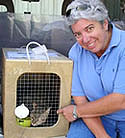 health, and placed on an international flight to San Francisco. An ACA volunteer met Hammer, who accompanied him on a domestic flight to his new home outside of Denver, Colorado. Bousfield, who returned a week earlier, his daughter Tiffany, and another member of the unit, Sgt. Robert Scott, met them upon arrival at Denver International Airport. PFC Hammer started to knead the ACA volunteer’s arm as soon as he heard Bousfield’s voice-the bond, formed thousands of miles away in adverse conditions, remained. The photograph in this paragraph reflects the special carrier made for Hammer for his international flight.
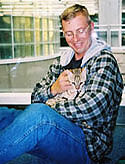
Hammer now lives with Bousfield’s family and five other cats, and is getting along well. This photograph shows Hammer being reunited with Bousfield in Denver:
You will find much more information regarding the transportation effort from the ACA website and the full story at the website for the American Forces Information Service, that is:
Alley Cat Allies – Saving Private Hammer
American Forces Information Service – PFC Hammer Finds a Home
Disclaimer: Kathy Fatheree is not at all a medical expert. Contents of this web site are a collection of Kathy’s assist feeding experiences as well as the experiences of other cat owners who have assist fed their cats. While every effort has been made to ensure the accuracy of the information, Kathy Fatheree or anyone associated with this web site cannot be held responsible for anything that may happen as a result of using the information on this site.