Vol. 1, No. 23
Table of Contents
Assist Feeding – Syringe Feeding Baby Food
Feline Nutrition – Vacation Tips
Pro-Active Cat Care – Hello, I’m A Kitten
Feline Obesity – Peer Pressure
Kitty Potpourri – The Most Famous Breed
Assist Feeding – Syringe Feeding Baby Food
by Kathy Fatheree
This past week, the question was raised about syringe feeding baby food as the main source of food. This is such a vitally important topic and I’m glad the question was asked!
We grow up thinking that baby food is such a good source of nutrition… after all, human babies seem to grow up on it just fine. Additionally, we tend to think that cats, being obligate carnivores, should thrive on meat baby foods. Unfortunately, this is very, very wrong. Cats cannot live on a diet of baby food.
One major caution to start off with is that many baby foods use onion powder. Read the labels VERY CAREFULLY. Cats should never, ever eat anything with onion. Cats can develop what’s called heinz anemia. The Felidae World web site writes:
“Heinz bodies are seen in cats that have been exposed to oxidants such as aspirin, and sulfonamides as well as certain plants. Cats should never have onions or too much garlic, which is in the onion family, since both cause Heinze body anemia.”
An additional reason why cats cannot live on a steady diet of baby food is that it lacks the essential nutrients specific to cats. Even if you add in vitamin supplements, it’s very hard to match the balanced nutrition in formulated cat foods.
Baby food can sometimes be sticky when trying to syringe feed and it’s tempting to water it down a bit to help with the flow. Adding water severely impacts the nutritional value AND calorie content and this practice is never recommended.
Your best bet when selecting a food to syringe feed is to start with a prescription food prescribed by your vet specific to your cat’s need. Some foods lend themselves to syringe feeding more than others so you will need to experiment.
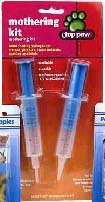
First, be sure to get a good syringe. The ones given to you by the vet are intended to be one-time-use syringes. The tip opening is really too small and can quickly clog, and the rubber plunger will quickly gum up on you. I personally like the syringes available at PetsMart and PetCo. The tapered tip of this syringe can be cut so that the opening is large enough to accommodate the type of food you use. (Notice the tapered tip of the syringe on the far right in this picture. Click here to go the the PetCo web site.)
Secondly, buy a food processor to puree the food. If you have a CRF kitty, I like the k/d minced. The k/d regular is just terrible… it’s dry, dry, dry… but the k/d minced has chunks and when puréed, it gets wetter and you may only need to add a few drops of water or broth. If your cat needs a high calorie / high protein food, I like the Hill’s a/d.
Let me know what foods YOU like to syringe feed by posting a message on our PurrTalk.com Cat Forum. I look forward to hearing from you.
Feline Nutrition – Vacation Tips
by Garry White
In ProActive Cat Care, we covered some general cautions about managing our kitties during summer vacations. Now, let’s carry that thread over into nutrition. First, let’s assume it’s just not practical to take Fluffy along with us on that Caribbean cruise, which leaves us with a few options: We can kennel-ize kitty while we’re away, but you already know that would be my very last consideration. We can find a house/kitty sitter, but that’s not always easy to do. Or, we can follow the beaten path and call on friends and neighbors to stop by and “take care” of Fluffy while we’re gone.
Secondly, let’s acknowledge a couple of things: One, Fluffy’s whole world is you, her existence relies on you being there, and you’re not going to be. So we can expect her to be upset in your absence. Two, understand that kitties (unlike their human counterparts) do not run to the Fridge during times of anxiety and depression. Just the opposite happens; they become reclusive, and typically they’ll lose interest in food. Uh-Oh! A normal-weight cat needs about 5 or 6 ounces of canned food every single day (or the dry equivalent), and without proper nutrition, many cats can suffer the risk of Hepatic Lipidosis.the recovery-rate for which is not at all attractive, by the way.
So.what to do. We want to have a good time on vacation, and we don’t want to come home to a crisis.
Don’t panic; there are some common-sense steps we can take that can make the situation livable.
- First of all, acknowledge that your neighbor doesn’t love Fluffy as you do; disrupting their life several times daily (to feed your cat) will be an inconvenience, at best. Which means.pick from the best of the lot!
- Do NOT ask 5 people to watch over Fluffy, hoping that more-people-means-better-care: Ask me about this sometime, and I’ll tell you (from experience) why it doesn’t work. Basically, what happens is this: Everyone thinks the other guy already took care of Fluffy for the day.
- Since you already know that Fluffy will be under the bed and wondering where you are by the second day, and ignoring the food bowl.prime the pump in advance. Stock up well on treats and food that she loves, and don’t burden your neighbor with trying to keep up with her regular diet.
- Spend time with your temporary caregiver in advance. Make sure that Fluffy and the person have bonded.
- Show the person where everything is stored, and be sure to leave clear, concise notes in the appropriate areas.
- Make sure to leave vet (and emergency-clinic) phone numbers in a conspicuous place.
- Don’t burden the person with trying to maintain the relationship that you have with Fluffy. Try to have them spend a few minutes with her when they can, and be sure to have treats for the caregiver, too: Perhaps specialty foods, maybe a stack of his/her favorite movies.anything that will encourage the person to “hang around” for a little while.
And when you finally return home, do something nice for the caregiver. Most folks won’t take money for helping you, but perhaps cook them a nice dinner, maybe a nice gift.something to show how important their efforts were, and how much you appreciate them. And be sure to send us a post card from the sunny Isle of Bingo-Bango.
ProActive Cat Care – Hello, I’m A Kitten
by Garry White
Hello, I’m a kitten. I’m kind of new here, and there are a lot of things I don’t know about this world yet. Come to think of it, there are only a few things I do know about, and they are very basic. For example, I’m okay with eating and drinking, but I think a piece of paper is almost as tasty as chicken in gravy. I suppose the chicken is better for me, and I sure hope my new keeper is aware that I’m just learning about stuff like this. Water is another issue: To me, water left in a bowl in the sink is downright good, but fresh water probably wouldn’t make me sick. Playing is something else altogether.I LOVE to play with things like pencils, thumbtacks, rubber bands, and such.although I probably shouldn’t. I think my keeper is on top of things like this, because there aren’t many “treasures” lying around (most of the time), and that toilet-bowl cover seems to always be down! Bummer! As a matter of fact, he’s somewhat of a spoilsport. There are lot of neat, fun things that are now out of my reach: Deodorants, razors, medications, cleaning things, stuff I don’t even know what it is.but I would if he’d just put those things down here a little closer!
My personal habits are another topic that seem to up often, too. See, I just have so much energy to burn and, as yet, I haven’t fully adapted to this business of schedules. I’m pretty sure I’ll settle into the routine, but right now it’s IALP.I‘m Awake Let’s Play. Do you think my keeper understands what I’m going through?
I have a big brother-kitty too, you know, and he is FUN! You should see how I can make him yell. But there are times when he doesn’t want to play, and we have.ummm.come to an understanding about that. I tell you, his paw is nearly as big as my whole head!
I’m learning, that’s the best I can do, and I bet they (my keeper and my brother) had to learn once, too. But I think they’re being very patient with me, and in turn I’m trying to pick things up quickly. But I’m a kitten, after all. One day, I hope to be a real “cat” like my big brother, but right now I’m just soaking up life at warp-speed. Do you think they understand me? I think.I think we’re all learning, don’t you?
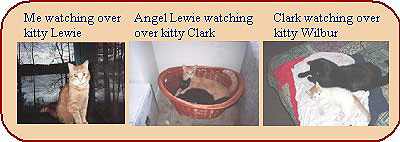
If you have a kitten in your life, know how special they are, know how fragile they are, and know how much they need you to watch over every single element of their life.
Feline Obesity – Peer Pressure
by Kathy Fatheree
If you have a multi-cat household and at least one of your cats is obese, your obese cat may be eating more than necessary because of the feeling of competition. In psychology terms, increased activity in the presence of others is called ‘social facilitation.’
I read an article from Rensselaer Polytechnic Institute in New York and the title of the article is “The Mere Presence of Others.” That kind of sums it up!
Cats eating side-by-side is really cute! However, eating in such close proximity may cause your cat to eat quickly without really tasting the food. Kitty may just gulp the food down as quickly as possible to be sure to get enough. Does your kitty ”inhale the food”? If so, it may be the survival of the fittest instinct kicking in. This is especially true if the obese cat does not feel entirely comfortable around your other cats.
If you suspect this type of eating behavior, try separating your cats at mealtime. You won’t necessarily need to shut each cat in separate rooms… unless you have one cat that likes to eat everyone else’s food… but around the corner and out of sight works best.
Try feeding each cat at separate “stations.” Cats are creatures of (some) habit, and they will quickly learn their feeding spot. My cat Phoebe, for example, will follow me and stand at my feet while I prepare her food, and then when I say “OK” she will run over to her spot, sit down and wait for me to present her food! Amazing! By keeping her about 10 feet away from my other cats while they all eat, she eats a little slower and is much noticeably calmer. Before, when Phoebe ate next to my other cats, she inhaled her food and even emitted an occasions territorial noise like a little growl.
My other cat Maya likes to eat by herself as well, however she changes her “feeding station” every 3 weeks or so! 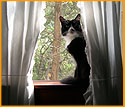 Maya will sit in a spot at feeding time (I meal feed 3 times per day) and not budge… looking at me with a serious look… and I know that she wants to be feed at that location! (Maya has the opposite problem from Phoebe though… she is too skinny… however when Maya eats at her station of choice, I can be sure she will eat all of her food without being distracted.)
So if you have a fat cat in a multi-cat household and you suspect social facilitation, try feeding the cats apart from each other to reduce the feeling of competition… and perhaps play some New Age music as well. 🙂
Kitty Potpourri – The Most Famous Breed
by Dan Malenski
Previously, we talked about the origin of cats… now let’s talk about different breeds! I asked the girls for help in choosing which breed to talk about first and true to form, they recommended talking about the most famous and cherished breed of all times… the Domestic House Cat (DHC)!
The DHC evolved over years of random breeding and is a very broad term that is sometimes broken down into several areas, such as the DSH (Domestic Short Hair). Due to  centuries of random breeding, the DHC may be seen in a multitude of body shapes and colors of their coat. Most are of the short haired variety, and that characteristic may be attributed to their genes being dominated by those of the American Short Hair. The American Short Hair is a pedigreed cat, and is not to be confused with the Domestic House Cat, but since the American Short Hair has been around since North America was colonized, their genes are likely widespread in the current gene pool for the DHC. (Information for the American Short Hair breed was obtained from the Cat Fanciers’ Association web site if you want to read more.)
The popularity of the DHC is likely due to it being available in so many colors and  variations in their coat and size, which makes for a series of endless choices. They are just as much a loving companion as a pedigreed cat. The only difference between a non-pedigreed and pedigreed cat is that the latter will produce kittens with like physical characteristics, coat and temperament, while a random-bred cat cannot.
The DHC is available in all colors and variations, with calicos  , solids, mixed, tabbies, and tortoiseshells just being some of them. Although the majority is of the short haired variety, there still is an abundance of the longhaired variety, many with huge bushy tails. The longhaired varieties likely stemmed from pedigreed cats such as the Maine Coon or the Norwegian Forest Cat. Although it is said that temperament is also a characteristic that remains consistent within specific breeds, this characteristic appears to vary the most. This may be due to several variables, such as how long they were with their littermates, how they
  interacted with them, and most of all because of the fact that each one of these creatures has its own unique personality. My experience with cats tells me that all cats have the propensity to be the most loving of creatures, regardless of their origin, i.e., whether they were born purebred or in an alley.
I’d like to comment on a reputed personality  characteristic of cats in general… and I’m referring to the notion of cats having the reputation of being unaffectionate or aloof… with aloof bothering the ‘unenlightened’ the most! I have never thought cats as unaffectionate or aloof, and have often attempted to find the reason why so many people think this way about our feline companions. I think that people who feel this way compare the cat with other creatures, and allow the fact to escape them that cats are creatures of their own, and will behave differently. My belief is that cats, as opposed to d*#s for example, will make you earn their trust and respect, but once you do so, you will have a lifelong companion of unsurpassed loyalty that could even transcend the lure of the food dish!
Now THAT is the cats meow.
Disclaimer: Kathy Fatheree is not at all a medical expert. Contents of this web site are a collection of Kathy’s assist feeding experiences as well as the experiences of other cat owners who have assist fed their cats. While every effort has been made to ensure the accuracy of the information, Kathy Fatheree or anyone associated with this web site cannot be held responsible for anything that may happen as a result of using the information on this site.