
Table of Contents
Assist Feeding – Feeding Styles
Feline Nutrition – Uh-oh!
Pro-Active Cat Care – Feline Stress
Feline Obesity – It’s 4:00 in the Morning!
Assist Feeding – Feeding Styles
by Kathy Fatheree
So what is the best way to assist feed using a syringe? How many stars are in the sky? The feeding style that you and your precious kitty develop will be totally unique just to you both. Your feeding style will depend on your kitty’s temperament, mood, how well he/she feels, your comfort level and so on. Some people syringe feed with their kitty sitting on the counter, others will feed their kitty while holding them in their arms like a baby. My precious Bubba sat in a chair while I sat on a foot stool. Everybody is different. It will take time, patience and love to figure out what is the best method for you both AND you will probably change styles a time or two along the way. Listen to how others syringe feed, ask questions and adapt techniques that will help you find the technique that your kitty will be most comfortable with.
Read about Linda and Mittens who have their own unique feeding style of assisted feeding as well.
Feline Nutrition – Uh-oh!
by Garry White
I have to break a promise. Last week, I told you we’d be comparing low-cost cat foods with those of apparent quality, and I have to renege on that. A lawyer-friend said: “Oh, goody! Let me know when you plan to do this, and I’ll set aside plenty of time to deal with the libel suits you’ll probably get slammed with.” You see, if I tell you personally that “XYZ” cat food is much better than “ABC”, it’s considered an opinion. If I say the same thing publicly, as in this Newsletter, it’s deemed a “statement” and is subject to legal recourse. So I cannot recommend or condemn. But I can show nutrient charts and ingredient listings, I can post them side-by-side, and I can point out higher-this and lower-that, so that you can draw your own conclusions…and that is what we’ll do. However, this extra work of gathering and compiling data will take a little longer than I had planned for, so please be patient.
Also, I’ve discovered that the issue of “good food/bad food” is extremely controversial and highly opinionated. For that reason alone, I will not recommend a particular food or condemn another. I will, however, take a stand on particular elements (ingredients) that I feel are detrimental (or helpful) to a cat’s health and longevity, and that “stand” is based solely on technical research.
Okay…enough about that. Let’s break into a topic that will involve more space than we have room for in one Newsletter, but we may as well get started.
 Canned food vs dry food: There seems to be a lot of discussion lately about eliminating dry food altogether from a cat’s diet. Beginning next week, we’ll start to cover these issues individually. But in the interim, please know that there are strong, valid arguments for both sides of this fence. Which means…don’t throw all of Sneaky Pete’s food away just yet.
ProActive Cat Care – Feline Stress
by Garry White
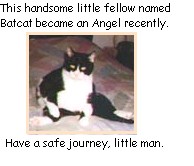 Batcat is a thinker; he has a mind of his very own, and those who doubt this need only to observe his daily habits, his routines. And especially his ability to be innovative, spontaneous, even sporadic in behavior; this alone tells you there’s a whole lot feelings and emotions going on between those perky little ears.
Since this is a safe and accurate assumption, we as caregivers need to take it a step farther and assume that Batcat is susceptible to yet another emotion… feline stress. As humans, our lives are always in a state of flux; change is to be expected and dealt with. The boss says we have to work the night-shift from now on and we grumble, but we adjust. We have to move to Florida, so we pack up our things and off we go. These simple references mean little to us, but to Batcat they can be devastating. Why? Because he’s not in control. He knows something is happening, but what? And worse: what’s going to happen next?
By nature, cats do not like change because they see it as a threat to their existence. Generally, cats will defend themselves against known enemies, but to them, change is an invisible enemy. Imagine that your world is perfect, idyllic; you wouldn’t change a single thing. Now imagine that all the powers in your life go behind closed doors to determine your fate, your future. You don’t know what will happen when they come out, but you do know that things will not be the same as they were, and… you’ll have no say in what happens; all you can do is comply. Would you be stressed in such a situation? Sure you would, but here’s the big difference: While we can probably deal with whatever comes next, Batcat is fearful that he cannot. Result? Feline Stress! And it’s a much deeper, all-consuming stress than you or I might experience over sudden changes.
So how can we deal with Batcat’s extreme sensitivity to change? Well, I’m going to defer to the professionals for this. I usually try to extract the meat of a topic and present it to you in summary form, but in this case my research uncovered such interesting and highly-informative information that I feel obligated to share it with you as it is. I have read until my eyes hurt, and I tell you… that can be pretty stressful!
Seriously, I firmly believe you’ll enjoy these various websites as much as I have, and it’s almost a certainty that you’ll learn a great deal more about Batcat’s total well-being, not just his medical state. Although… you’ll soon see the link between mental and physical, and you’ll discover the horrors that feline stress can do to a cat, as well as how to avoid that risk.
ProActive Cat Care – Feline Stress
Feline Obesity – It’s 4:00 in the Morning!
by Kathy Fatheree
Ok… so you have your kitty on a weight loss program and it seems to be going well for the first week or two. You think “this diet thing just might work after all.” Then all of a sudden your kitty starts waking you up at 4:00 in the morning for breakfast! Argggg! Morning after morning you’re awakened and you eventually give up and start free feeding again! There goes another perfectly good cat diet! What’s a parent to do?
Here’s an idea: Buy a automatic timed feeder and set the little machine to open at 4:00 in the morning! Presto! Your kitty will quickly learn to stare at the feeder instead of pushing your nose!
Here are some automatic cat feeder ideas:
Automatic Cat Feeder, 5 Meals
This automatic cat feeder keeps your pet on her regular feeding schedule when you can’t be there to feed her yourself. Automatic feeder feeds up to 5 meals over the course of up to 4 days. Use with dry or canned food; twin ice packs help to keep food fresh. Runs on one “AA” battery.
Automatic Pet Feeder, 2 Meals
Set the timer, and the lid pops open to feed pets on schedule! Two dishes with 48 hour timer and ice pack. Holds 1 lb. canned or 2 cups dry food. 9″W x 7″D x 3″H. Battery required.


CSF-3 Cat Super Feeder, Stand, Bowl and Timer
This automatic pet feeder has been rated as one of the best. It can be set to feed multiple times day and night. It has a stainless steel bowl and it’s one of the more difficult feeders for clever cats to get in to! Plugs into an AC outlet.
$139

Disclaimer: Kathy Fatheree is not at all a medical expert. Contents of this web site are a collection of Kathy’s assist feeding experiences as well as the experiences of other cat owners who have assist fed their cats. While every effort has been made to ensure the accuracy of the information, Kathy Fatheree or anyone associated with this web site cannot be held responsible for anything that may happen as a result of using the information on this site.